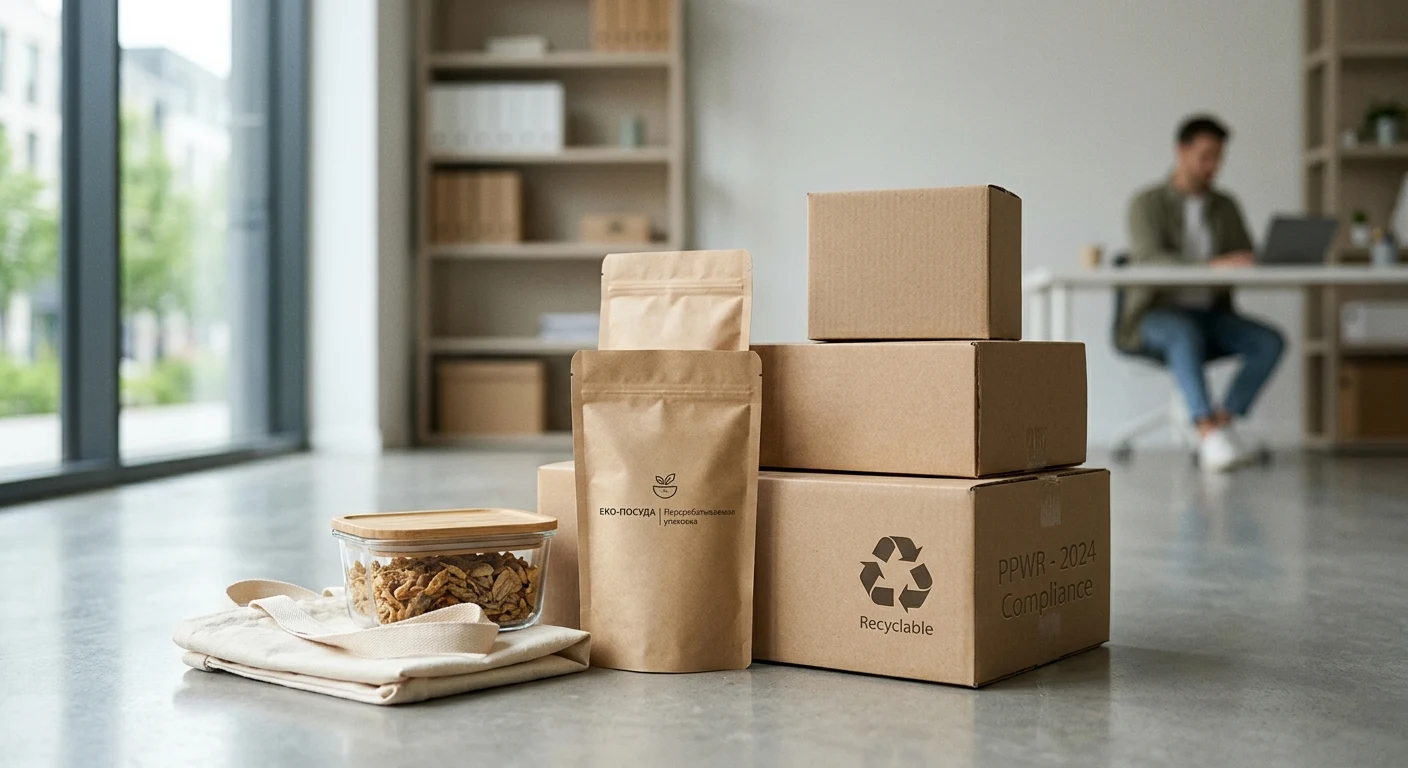
As of August 12, 2026, a new Packaging and Packaging Waste Regulation (PPWR) applies in all EU countries. It affects not only factories, but any business that sells goods in boxes, bags, or envelopes.
- Who it applies to. Almost everyone who packages and ships goods to customers in the EU: online stores, handmade artisans, manufacturers, and importers.
- The key news for small businesses. If you sell directly to customers in another EU country, you are considered a packaging “producer” in that country. You must register there, pay a recycling fee, and, as a general rule, appoint a local representative.
- For food and cosmetics. Food-contact packaging must not contain “forever chemicals” (PFAS) above the established limits.
- Правило «не более 50% воздуха в коробке». It will not take effect until January 1, 2030.
- Penalties. There is no single EU-wide fine. Each country must set its own penalties by February 12, 2027. Germany has already introduced fines of up to €200,000.
- The rules may be relaxed. Brussels is discussing removing the mandatory representative requirement for small companies, but no decision has yet been made.
This article is current as of November 10, 2026, and is not a substitute for legal advice: the rules vary from country to country and are subject to change.
What is the PPWR and why is it needed?
PPWR (Packaging and Packaging Waste Regulation) is the EU Regulation 2025/40 on packaging and packaging waste. It entered into force on February 11, 2025, and applies from August 12, 2026, with many requirements being phased in (Campden BRI).
This is a regulation, not a directive. The difference is simple: each country transposed a directive into its national law in its own way, whereas a regulation applies directly and uniformly in all 27 countries (ChemRadar). It replaced the old 1994 Packaging Directive.
Why it is needed. The goal is to reduce packaging waste, make packaging recyclable, and eliminate harmful substances from it. Therefore, the regulation contains three sets of rules:
- What packaging is made of and how it is designed: chemical composition, size, recyclability.
- Who pays for its disposal: the extended producer responsibility (EPR) principle.
- How compliance is verified: declarations, registrations, labeling, fines.
What is EPR in simple terms? The party that first places packaging on the market pays for its collection and recycling. This is not a tax paid into the government budget, but a contribution to the recycling system. It is usually paid through a producer responsibility organization (PRO) or directly to a national register. This system has existed in Europe for some time. What is new is that the rules are now harmonized across all countries and apply to cross-border sales.
Who is a “producer,” and why is it most likely you?
The key term in the regulation is “producer.” This is not necessarily the party that physically makes the box or product. Under the regulation, it is the party that is the first to make packaging or a packaged product available on the market of a specific EU country. This is the party charged the recycling contribution. The same party may be both the manufacturer and the “producer,” but not always: in cross-border sales arrangements, they may be different companies (Verpackungsregister, Coolset).
What this means in practice:
| Situation | Who is the “producer”? |
|---|---|
| You sell directly to a customer in another EU country (through your own website, Etsy, Instagram, etc.) | You, in the customer's country, regardless of where your business is registered (PAQR) |
| You buy standard unbranded boxes from a local supplier and only ship goods within your own country | In many cases, it is the packaging supplier, not you. In Germany, this is explained as follows for German suppliers (E-Commerce Germany) |
| You sell from a country outside the EU into the EU | The foreign seller is the “producer” (EPR Representative) |
| You use a fulfillment warehouse in another country | It depends on the contract. The regulation expressly provides for the role of fulfillment operators (Coolset), so check with them |
Important note: these are the general rules under the regulation. The exact definition in your country depends on national law and on your business model (your own brand, resale, or dropshipping). If in doubt, check with the national registry.
What exactly does a “producer” need to do?
If, under the rules above, you are a “producer” in a particular country, you have four obligations. They apply separately in each country where you sell.
- Register in the national producer register (Article 44 of the regulation). This is mandatory even if you have joined a recycling organization (Lappa).
- Pay a recycling fee. The amount depends on the weight and packaging material, as well as the country's rates.
- Submit reports: the quantity and types of packaging you placed on the market (weight by material).
- Appoint a local representative, if you are not registered in that country. Article 45(3) requires you to authorize a representative in writing in each country where you first make packaging or packaged goods available, except the country where you are registered (National Law Review). There is no single “one-stop shop” for all countries: if you sell in Germany, France, and Italy, you need three representatives (EPR Representative). This is the most expensive part of the rules for small businesses, which is why efforts are now being made to ease this requirement (see the section on the Omnibus).
Marketplaces. Article 45(4) requires online platforms to verify that sellers have fulfilled their obligations (ComplianceGate). Without registration, the product may be removed from sale.
Examples from two countries.
- Germany. Registration in the LUCID register maintained by Zentrale Stelle Verpackungsregister. You must register under your company's name: the registration number of the service that ships parcels on your behalf does not cover you (Printful). The party that invoices the end customer is considered the “producer” in Germany.
- Lithuania. Registration in the GPAIS system. According to an overview by RegSurance, GPAIS reports are submitted quarterly, while the annual report for 2026 is due by January 30, 2027 (RegSurance). As of September 2, 2026, it had not been officially clarified how foreign companies would register through a representative (Lithuanian Environmental Protection Agency). Follow GPAIS news.
Timeline: what applies now and what comes later
Не всё из регламента вступило в силу одновременно. Многие громкие требования, например «не более 50% воздуха», появятся только в 2030 году. Из основных норм статьи 5 в полной мере с 12 августа 2026 года действуют именно требования к веществам (Campden BRI).
| Date | What happens |
|---|---|
| February 11, 2025 | The regulation entered into force |
| August 12, 2026 | The regulation applies. The following take effect: PFAS limits in food packaging, an overall heavy metals limit (100 mg/kg in total), the obligation to minimize hazardous substances, registration and an authorized representative for “manufacturers,” and the general principle that packaging must be recyclable (Coolset, Italian Food News) |
| February 12, 2027 | EU countries must adopt rules on penalties (Article 68). Cafés and restaurants must allow customers to bring their own containers (RegSurance) |
| February 12, 2028 | The European Commission must adopt a method for calculating empty space in packaging (Fieldfisher) |
| August 12, 2028 | Harmonized packaging labels for sorting (Ecoparcel) |
| January 1, 2030 | Максимум 50% пустого пространства в коробках для интернет-торговли. Детальные критерии пригодности к переработке. Требования к доле вторичного сырья (Ecoparcel, RegSurance) |
| 2035 | The strictest recyclability classes (Ecoparcel) |
Packaging for food, tea, and confectionery: PFAS
What are PFAS? They are a group of chemical substances that do not break down in nature, which is why they are known as “forever chemicals.” They are added to paper and cardboard to make them water- and grease-resistant—for example, baking paper, fast-food boxes, and confectionery bags.
What exactly has changed? From August 12, 2026, food-contact packaging may not be placed on the EU market if its PFAS content meets or exceeds any of the following three limits (Sunhat):
- 25 ppb for any individual substance;
- 250 ppb for the sum of non-polymeric PFAS;
- 50 ppm in total for all PFAS combined, including polymeric PFAS.
This is not a complete ban on all water- or grease-repellent treatments, but rather a set of concentration limits (Syncforce). However, compliance cannot be verified without laboratory data, so in practice, using a conventional “glossy” treatment without documentation is risky.
Important details:
- The rule applies to all food packaging, including packaging imported from abroad (Tracextech).
- Packaging placed on the EU market before August 12, 2026 may remain on sale. Packaging first placed on the market after that date must comply with the limits, even if it was manufactured earlier (RegSurance).
- Each type of food packaging requires a declaration of conformity and technical documentation containing PFAS test results (TraceOne). If you buy ready-made packaging, this is usually a supplier document that you need to request and keep.
What to do. Buy food packaging from suppliers that provide a declaration and a PFAS test report. If a supplier cannot verify the composition, choose another one.
Air in the box: the 50% rule will take effect in 2030
News reports often say that “empty space in a parcel must not exceed half of its volume.” This is true, but not from 2026, but from January 1, 2030 (or 36 months after the calculation methodology is adopted, if that is later). For now, only the general principle of “do not use more packaging than necessary” and restrictions on substances (Claimlane, Fieldfisher).
How it is calculated. Empty space is the volume of the box minus the volume of the product in its own packaging. Responsibility lies with whoever packs the parcel (RegSurance).
The catch: void fill is also considered empty space. Air pillows, bubble wrap, foam, and even crumpled paper all count as “air” (Ecoparcel). Therefore, the advice to “replace plastic wrap with crumpled paper” does not help you comply with this rule: you need a properly sized box, not different void fill. If the product ships in its own packaging with a single label, the 50% limit does not apply (RegSurance).
What you can do right now. Measure how much of the volume in your typical shipments is occupied by the product, and choose boxes that more closely match the size of the items. This will save you money on shipping and materials today.
How much does it cost?
Packaging costs consist of three components, not two: registration in the national register (free in many countries, such as Germany’s LUCID), a weight-based fee paid to a recycling organization, and the services of a local representative, if required.
For small volumes, the weight-based fee itself is usually only a few dozen euros per year: in Germany, low-volume plans start at around €39, while minimum annual payments are often in the €20–100 range. The largest part of the bill is generally the representative or service provider that handles registration and reporting. According to industry estimates, for a small online seller (50–200 kg of packaging per year per country), typical annual costs are as follows: Germany — around €100–800; France — €150–600 (including a fixed fee of around €80 for small volumes); Spain — €100–500; Italy — €50–300; Austria — €150–700. However, Austria’s simplified plan for volumes of up to 1 500 kg costs approximately €130–200 per year. These are service-provider estimates rather than official rates, and the actual amount depends on the materials, weight, and company selected. In the Netherlands, the fee and annual declaration apply only from 50 000 kg of packaging per year. If you ship goods to three or four countries, the total will most often range from several hundred to several thousand euros per year.
- DutyScope: EPR fees by country 2026
- Assuro: how much EPR costs for a small seller
- Assuro: EPR by country
- Verpackungslizenz24: Austria
- Lappa: Austria
- Paperjam: small sellers and PPWR
- Taxually: PPWR for online sellers
- Value Added Resource: Etsy and PPWR
- Catawiki: EPR and Private Sellers
Is Vinted the only thing that can save us?
Just an idea: I'm seeing a lot of shops moving to Vinted now and selling what they claim are second-hand goods… Vinted isn't a solution. EPR is intended for business sellers. It generally does not apply to private individuals who occasionally sell second-hand items. If you are a sole proprietor selling new products, the platform does not change your status.
Where to buy packaging: China, your home country, or another EU country
A common piece of advice is: “Only buy packaging in your own country, period.” There is some truth to this, but it is an oversimplification. It is important to distinguish between two different responsibilities: who is responsible for the box itself and who is responsible for your shipment containing the product.
| Where the packaging was purchased | What happens | What to look for |
|---|---|---|
| In China (AliExpress, Temu, direct suppliers) | The rules apply to imported packaging in the same way as to any other packaging (Tracextech). Who is responsible for first placing it on the EU market depends on the arrangement: it may be the foreign seller, or it may be the party importing the goods (Coolset) | A random seller often lacks declarations on PFAS and heavy metals, but these are mandatory for food packaging. Customs duties and import VAT are a separate matter and are unrelated to the PPWR |
| From a local supplier in your country | Standard unbranded boxes: in many cases, responsibility for the packaging lies with the supplier (E-Commerce Germany) | Ask the supplier for a declaration of conformity, especially for food packaging. This is not an “environmental certificate,” but a document detailing its composition |
| In another EU country | The rules are the same as for a local supplier | A supplier from another country must also fulfill the obligations of a “producer” in your country (registration and appointing a representative). Check whether they do this and ask for a declaration |
However, if you ship parcels to another EU country, buying the “right” box will not protect you. As the “producer,” you are responsible for your parcel’s packaging in the buyer’s country: registration, payment of a fee, and appointing a representative (see above). Where the box came from is irrelevant here.
“So we pay twice?” This is a common complaint in videos. Formally, these are two different payments. The buyer pays the local municipal service for waste collection, while the “producer” pays a fee into the packaging recycling system in the country where the packaging becomes waste. Whether this is fair to small businesses is debatable; that is why entrepreneurs are calling for simpler rules, and the EU is discussing them (see the section on Omnibus).
Penalties: what is known and what is not yet known
There is no single EU-wide penalty. The regulation itself does not specify amounts. Article 68 requires each country to introduce “effective, proportionate and dissuasive” penalties and notify the European Commission of them by February 12, 2027. For violations of Articles 24–29 (excessive packaging, reusable packaging, etc.), the penalties must include administrative fines (EUR-Lex, Carbonorm). The regulation does not establish criminal penalties.
Until national rules are adopted, inspections are carried out under the country's existing packaging and producer responsibility rules (Certivo). Here is what is known for individual countries:
| Country | What is known | Data reliability |
|---|---|---|
| Germany | The VerpackDG Act (July 13, 2026) takes effect on August 12, 2026. The fine for failure to register is up to €100,000, while other violations carry fines ranging from €10,000 to €200,000. Goods may be confiscated (FreshPlaza, Printful). Penalties for direct violations of the PPWR apply from February 12, 2027 (Polygon) | Industry overviews; amounts are consistent across multiple sources |
| Netherlands | Inspections are conducted by the ILT inspectorate. Administrative fines under environmental law and possible daily penalties for each day of non-compliance are expected (PPWR Connect) | Forecast; amounts are not final |
| Lithuania | The Law on Packaging and Packaging Waste (IX-517) is in effect. A bill implementing the PPWR was submitted to the Seimas on June 30, 2026, and had not been adopted at the time of review (RegSurance). A third-party reference source states a maximum of €58,000 (Ekoniq) | The amount has not been confirmed by an official source. Check the website Environmental protection agencies |
| France | A third-party review cites fines of up to €30,000 for violations and restrictions on online sales (VAT Compliance) | Third-party reference source; check with the national authority |
In addition to fines possible penalties include a sales ban, removal of the product from the marketplace, and a record of the violation in ICSMS, the EU-wide market surveillance database accessible to authorities in all countries (DPP Tool).
Will small businesses be fined right away? There is no single answer. In its Q&A (August 2026), the European Commission recommended that countries issue warnings first rather than impose penalties, and avoid disrupting trade and supplies (FoodTimes). The media also reported that a senior European Commission official urged countries not to enforce certain provisions or impose penalties (Brussels Signal). However, each country will make its own decision, and in Germany, some sellers have reportedly already stopped shipping goods abroad because of the new rules (FoodTimes). Do not assume that “no one will check.”
What may ease the burden: the Omnibus package
Efforts are already underway to ease the most burdensome part of the rules for small businesses: the requirement to have an authorized representative in every country.
- December 10, 2025 The European Commission proposed suspending the application of Article 45(3) until January 1, 2035 (National Law Review). This is part of the Omnibus VIII simplification package.
- What remains. The requirement is not being abolished for manufacturers outside the EU, and EU countries may still require a representative or ensure oversight by other means (Lovguiden).
- October 21, 2026 The Council of the EU has adopted its position on suspending this requirement (ibid.).
- The European Parliament is considering a narrower option: exempting only micro and small enterprises (up to 50 employees and turnover of up to €10 million) (Landbell Group).
- EU leaders have set a goal of reaching agreement on the simplification packages by the end of 2026 (EU Council document).
What this means for you. Until the simplification legislation is adopted, the existing rules remain in force, and you should not assume they will be repealed. Even if the suspension is approved, it will apply only to the authorized representative. Registration, reporting, and recycling fees will remain mandatory. The eligibility criteria for the exemption may differ from the original proposal, so keep an eye out for the final text.
A step-by-step plan for businesses
- List the countries. How many parcels you ship each year and where you send them. Domestic sales and sales to other EU countries are regulated differently.
- Determine your role in each country. Do you sell directly to customers, through a marketplace, or via a fulfillment warehouse? Ask the platform or warehouse whether they assume the “producer” obligations (registration), and obtain written confirmation.
- Verify your registration. In your country, this is the national register (for example, GPAIS in Lithuania). In Germany, registration in LUCID under your company name is mandatory.
- Arrange for a representative. If you sell directly to another EU country and are required to appoint a representative, compare service fees. Find out whether the Omnibus changes may eliminate all or part of this obligation.
- Gather your packaging data. Determine which materials you use (cardboard, paper, plastic, wood, textiles) and their annual weight. These figures are required for reporting and fees.
- Request documents from your suppliers. For food packaging: a declaration of conformity and PFAS test results. For all packaging: confirmation of compliance with heavy metal limits.
- Choose appropriately sized boxes. Don't wait until 2030: less empty space means less material, lower weight, and cheaper shipping.
- Keep track of the deadlines. February 12, 2027 — the date of adoption of national penalty rules. Then August 12, 2028 (labeling) and January 1, 2030 (50% empty space).
- Do the math. For very small sales volumes in a particular country, registration and an authorized representative may cost more than the sales generate. But before withdrawing from the market, check whether that country offers exemptions for small volumes and whether your warehouse or platform can take on the obligations.
This plan is not a substitute for advice from a lawyer or specialist organization and should be verified for each country.
Common mistakes and misconceptions
There are many oversimplified explanations of the PPWR in blogs and videos. Here is what you should double-check.
| What people say | What is actually true |
|---|---|
| “It only applies to handmade products and manufacturers” | Applies to almost anyone placing packaging or packaged goods on the market: retailers, importers, distributors, online stores (Normec) |
| “Buy from China—and you automatically pay taxes and undergo inspections” | Responsibility depends on who first places the packaging on the EU market. “Taxes” is not quite the right word here: it is a contribution to the recycling system, while customs duties and VAT are a separate matter |
| “Buy domestically—and there is nothing you need to do” | The supplier is often primarily responsible for the box, but you are responsible for shipping your product to another country. For food, PFAS documentation is still required |
| «Пустого места теперь не больше 50%» | This rule will take effect on January 1, 2030 |
| “Replace bubble wrap with crumpled paper, and you’ll be fine” | Filling material, including paper, is considered empty space. A smaller box is required |
| “There is a list of permitted materials: cardboard, kraft paper, linen, wood” | The regulation does not contain a list of materials that are “allowed / prohibited.” It sets requirements for substances and recyclability, with detailed recyclability criteria to be introduced later |
| “Wood requires a phytosanitary mark under the PPWR” | As far as we know, this is governed by separate regulations (wood packaging in international trade); the PPWR contains no such requirement |
| “All water- and grease-repellent treatments are prohibited” | PFAS content in food packaging is restricted above the specified limits. The PFAS limits apply only to food-contact packaging, not to cosmetics (Coolset) |
| “Paying twice is absurd” | These are two separate payments for different things. Whether this is fair is debatable, which is precisely why simplifications are being discussed |
Sources
The data was compiled as of November 10, 2026, from the text of the regulation, materials published by EU bodies, and industry reviews. Check country-specific fines on the websites of national authorities, as the relevant laws are still being finalized.
Official and institutional
- Regulation (EU) 2025/40, EUR-Lex
- Lithuanian Environmental Protection Agency: Extended Producer Responsibility
- European Commission: Omnibus simplification packages
- Council of the EU: document ST-13583/2026
- Zentrale Stelle Verpackungsregister: roles and responsibilities and definition of producer
Legal and industry overviews
- Campden BRI: key PPWR changes
- Fieldfisher: 10 key things about the new rules
- Coolset: PFAS and heavy metals and roles in the supply chain
- National Law Review: Environmental Omnibus
- Landbell Group: Omnibus and PPWR news
- Lovguiden: EU Council position of October 21, 2026
- Italian Food News: new guidelines
- Normec: PPWR applies
- ChemRadar: PFAS in packaging
PFAS and food packaging
- Sunhat: PFAS limits
- Syncforce: PFAS in food packaging
- Tracextech: PFAS and imports
- TraceOne: food packaging
- RegSurance: food company readiness
Representative, producer, EPR
- Tracextech: PPWR representative
- ComplianceGate: guide to representatives
- EPR Representative: Article 45
- PAQR: who is a producer?
- E-Commerce Germany: what to expect
- Lappa: EPR in Lithuania
- RegSurance: Deadlines in Lithuania and Lithuania Guide
- Printful: Registration in Germany
Empty Space in Packages
- Ecoparcel: What Is PPWR?
- Claimlane: Packaging Rules and Returns
- RegSurance: E-Commerce Table and Article 24 Requirements
Penalties and Enforcement
- Carbonorm: PPWR Penalties
- Polygon: Penalties and Enforcement
- DPP Tool: Penalties and Enforcement
- Certivo: Penalties by Country
- FreshPlaza: Penalties in Germany
- PPWR Connect: The Netherlands
- VAT Compliance: Penalties by Country
- Ekoniq: Lithuania Guide
- FoodTimes: PPWR and Reform
- Brussels Signal: European Commission's Position on Penalties




Comments0
Leave a comment
Enter your email—we'll send you a one-time code. No password or registration required.
Your email is only used for the login code and notifications about replies (you can unsubscribe using the link in the email). It is not published or shared with third parties. After you log in, a cookie is stored for 30 days. You can download or delete your data in your account.
Enter the code
Code sent to . If the email doesn't arrive within a few minutes, check your Spam and Promotions folders.
Your name and comment will be displayed publicly. Your email address will not be published.
I want a comment system like this for my website