
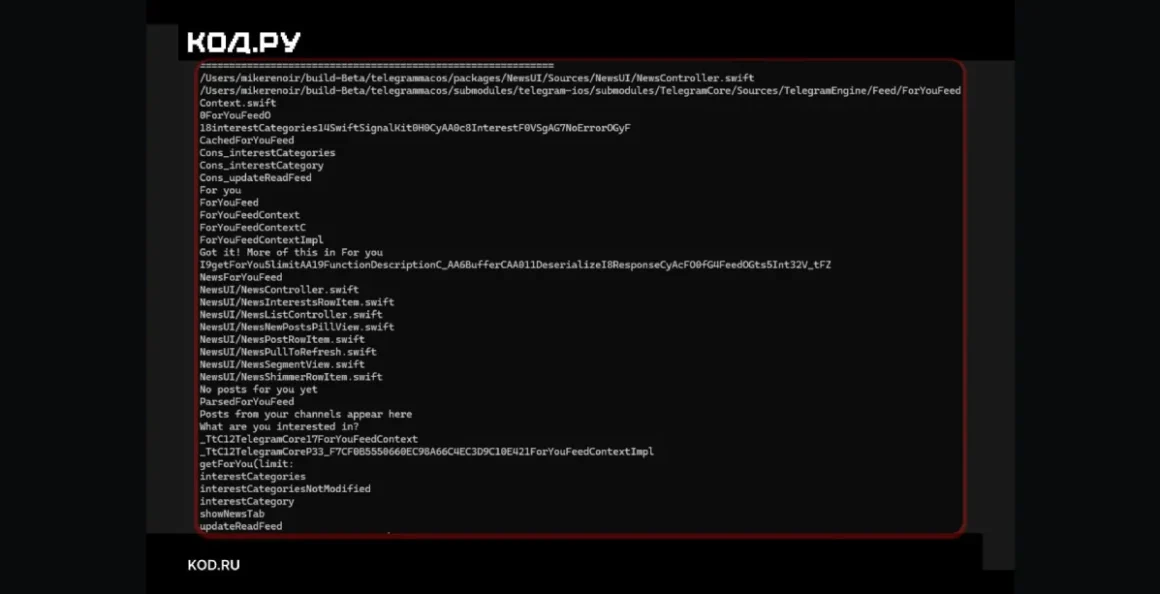
A dedicated “News” tab featuring posts from channels has been discovered in the beta version of Telegram for macOS. Based on the interface elements found, it will have two sections: one for sources selected by users themselves, and another for recommendations. If this feature launches, Telegram could change its traditional content distribution model. But will it make it easier to build an audience—or, on the contrary, will the largest channels end up getting all the views?
Editorial Team @tginfo writes that the introduction of an algorithmic feed similar to that of X (formerly Twitter) could significantly change how content is consumed in the messenger. For creators, it could provide a source of free organic traffic without having to buy ads, while for Telegram itself, it could boost audience engagement and increase impressions for official ads.
For a long time, Telegram operated on a relatively straightforward principle: users subscribe to a channel and receive its posts in their main chat feed. If creators want to grow their audience, they have to find ways to attract new subscribers—buying ads, arranging cross-promotions, relying on forwards, or getting recommended by similar channels.
Now, judging by discoveries in the beta version of the macOS app, Telegram may add a full-fledged recommendation feed to this system.
It is expected to have two sections. In “Added,” users will be able to curate channels they are interested in themselves. In “For You,” Telegram will suggest content based on selected topic categories. The interface also includes search, a counter for new posts, and the ability to go directly to a post, channel, or chat.
It is not yet clear exactly how the recommendations will work, which sources will be eligible for inclusion, or whether posts from channels the user has not subscribed to will be shown. Telegram has not disclosed its ranking criteria either. So it is too early to speak of a finalized algorithm.
But even hypothetically, this feature raises an important question: what will happen to Telegram's economy if views begin to depend not only on the number of subscribers, but also on the algorithm's decisions?
Why This Could Change Telegram
The defining feature of Telegram’s current model is that subscribing is one of the main ways to regularly receive content from a particular creator. A channel may have hundreds of thousands of subscribers, but a new reader usually discovers it through advertising, search, a forwarded message, or another user’s recommendation.
An algorithmic feed could change this sequence. Users would no longer necessarily have to first learn about a channel, open it, and subscribe. They could see an individual post, become interested in it, and only then visit the source.
In other words, Telegram may begin competing for users’ attention not only as a messenger, but also as a content consumption platform.
For creators, this is a fundamental change. If recommendations bring posts to audiences beyond their existing followers, channels will gain an additional source of organic traffic.
However, if the algorithm predominantly shows content from already popular sources, the new feed could exacerbate existing inequalities.
This is precisely where the line between two possible scenarios lies.
Small channels: a chance to reach beyond their existing audience
For smaller creators, the new feed could be good news. Today, even a high-quality channel with several thousand subscribers often struggles to grow: to attract a new audience, it has to pay for advertising or spend time promoting itself in other communities.
Recommendations could potentially overcome this barrier. For example, a small technology channel could gain views from an in-depth review of a new device, even if most users have never heard of the channel before.
Under this model, it is not only the size of the channel that matters, but also the appeal of a specific post. If the algorithm genuinely assesses interest in posts and can show them to a new audience, smaller creators gain the opportunity to compete with major publishers, at least at the level of individual pieces of content.
This could be especially useful for niche channels covering science, professional expertise, local events, culture, or specialized interests. Their potential audience may be small relative to Telegram as a whole, but engaged enough to read their posts regularly.
However, there is one major caveat. Algorithmic recommendations do not necessarily mean equal opportunities.
If Telegram relies primarily on existing popularity, subscriber counts, engagement history, or other metrics, large channels may gain an advantage before the competition for a new audience even begins. They have more readers, more potential reactions, and probably more data on which posts resonate.
In that case, smaller creators will have to compete not only with other channels, but also with a system that may be more likely to favor sources that have already proven themselves.
Therefore, the key question for small channels is not whether recommendations appear, but whether the algorithm can give a chance to a post that readers find interesting but has not yet become popular.
Large channels: greater reach, but less control
The new feed may also benefit large channels. If the algorithm starts recommending posts to people who do not yet follow the source, popular creators will gain an additional opportunity to expand their audience.
Large channels already have several advantages: brand recognition, regular content publishing, an established audience, and the ability to quickly attract initial views. All of this can help posts gain popularity if the algorithm takes user engagement into account.
But this model also has a downside.
A subscriber is no longer a guarantee of attention. Even if someone follows a channel, the algorithmic feed may show them some posts more often than others—or leave a significant portion of the content out of its recommendations altogether.
As a result, subscriber count may become a less reliable indicator of actual reach. This also matters to advertisers: a large subscriber base alone does not guarantee that a sponsored post will receive the expected number of views.
Still, it would be a mistake to assume that recommendations will necessarily reduce the reach of large channels. On the contrary, they may attract an additional audience and increase the total number of views. Everything will depend on how the new feed works alongside regular subscriptions and which content the algorithm favors.
Thus, the main risk for large channels is not so much losing their audience as losing predictability. A creator may have a large subscriber base but less control over what share of that base sees a particular post.
Knowing Pavel Durov, one can assume that he might charge channel owners Stars for inclusion in the recommendations feed… Of course, there are various ways to collect a “fee” for recommendations: through Premium subscriptions, boosts, or a monthly payment based on the number of posts or potential reach.
Who else stands to benefit
The changes may affect more than just channel creators.
For users, the new feed could make it easier to find interesting content. Today, people often discover new sources by chance—through forwarded posts, advertising, or recommendations from friends. A personalized feed could make this process more convenient.
But that convenience comes at a price. Users will see not only the posts they chose themselves, but also those selected for them by the system. If the recommendations become intrusive or keep repeating popular topics, the feed risks turning into yet another source of information overload.
The potential impact will extend to the advertising market as well.
If small channels begin consistently receiving views through recommendations, advertisers will be able to turn their attention to new niche platforms. This could broaden their options and give smaller creators additional opportunities to earn money.
But if a handful of major sources receive the bulk of recommended views, the advertising market could become even more concentrated. In that case, rather than opening up new opportunities, the new feature would strengthen the advantage of those who were already in a dominant position without it.
For now, it is impossible to say which of these scenarios will be closer to reality.
The main risk is dependence on an opaque algorithm
The experience of other platforms shows that algorithmic recommendations can both increase content reach and make its distribution less predictable for creators.
If Telegram follows this path, content creators will have to consider not only the interests of their own subscribers, but also the potential requirements of the recommendation system. This could affect their choice of topics, how they format their posts, and how frequently they publish.
However, it is too early to conclude that Telegram will necessarily start promoting sensational headlines, provocative content, or posts with a large number of reactions. To do so, we would need to know at least the basic principles behind the algorithm.
There is another question: will creators receive enough statistics to understand where their views came from? If recommendations appear as a separate traffic source in analytics, channels will be able to assess their effectiveness. Without this information, creators will find it more difficult to distinguish organic growth from random fluctuations in reach.
This is especially important for small channels: without transparent statistics, it is difficult to understand why one post received many views while another did not.
What This Means for Telegram as a Whole
The introduction of a separate recommendations feed could mark a shift from a model in which users primarily read selected sources to one in which the platform itself plays a role in selecting content.
This is not necessarily a bad thing. Recommendations can help people discover quality posts and new creators while making channel growth less dependent on advertising budgets.
But they may also intensify competition for attention, make reach less predictable, and increase creators' dependence on the platform's decisions.
Everything will depend on the details: which posts make it into recommendations, whether channels with no subscribers can appear there, how heavily the system will weigh a source's popularity, and which analytics tools creators will receive.
For now, the new feed exists only as a set of elements discovered in the beta version. It is unclear when it will become available to users or whether its current concept will remain unchanged.
If Telegram does launch recommendations, small channels may gain a new way to grow, while large ones could gain an additional source of views. But neither should expect the algorithm to automatically make promotion easier just yet.
Ultimately, the question is not whether Telegram will have recommendations. The question is what exactly Telegram will recommend: interesting posts regardless of channel size, or primarily content from those who have already proven their popularity. The answer will determine whether the new feed becomes a tool for competition or yet another mechanism for concentrating attention.



Comments0
Leave a comment
Enter your email—we'll send you a one-time code. No password or registration required.
Your email is only used for the login code and notifications about replies (you can unsubscribe using the link in the email). It is not published or shared with third parties. After you log in, a cookie is stored for 30 days. You can download or delete your data in your account.
Enter the code
Code sent to . If the email doesn't arrive within a few minutes, check your Spam and Promotions folders.
Your name and comment will be displayed publicly. Your email address will not be published.
I want a comment system like this for my website